DRY LAB : Model

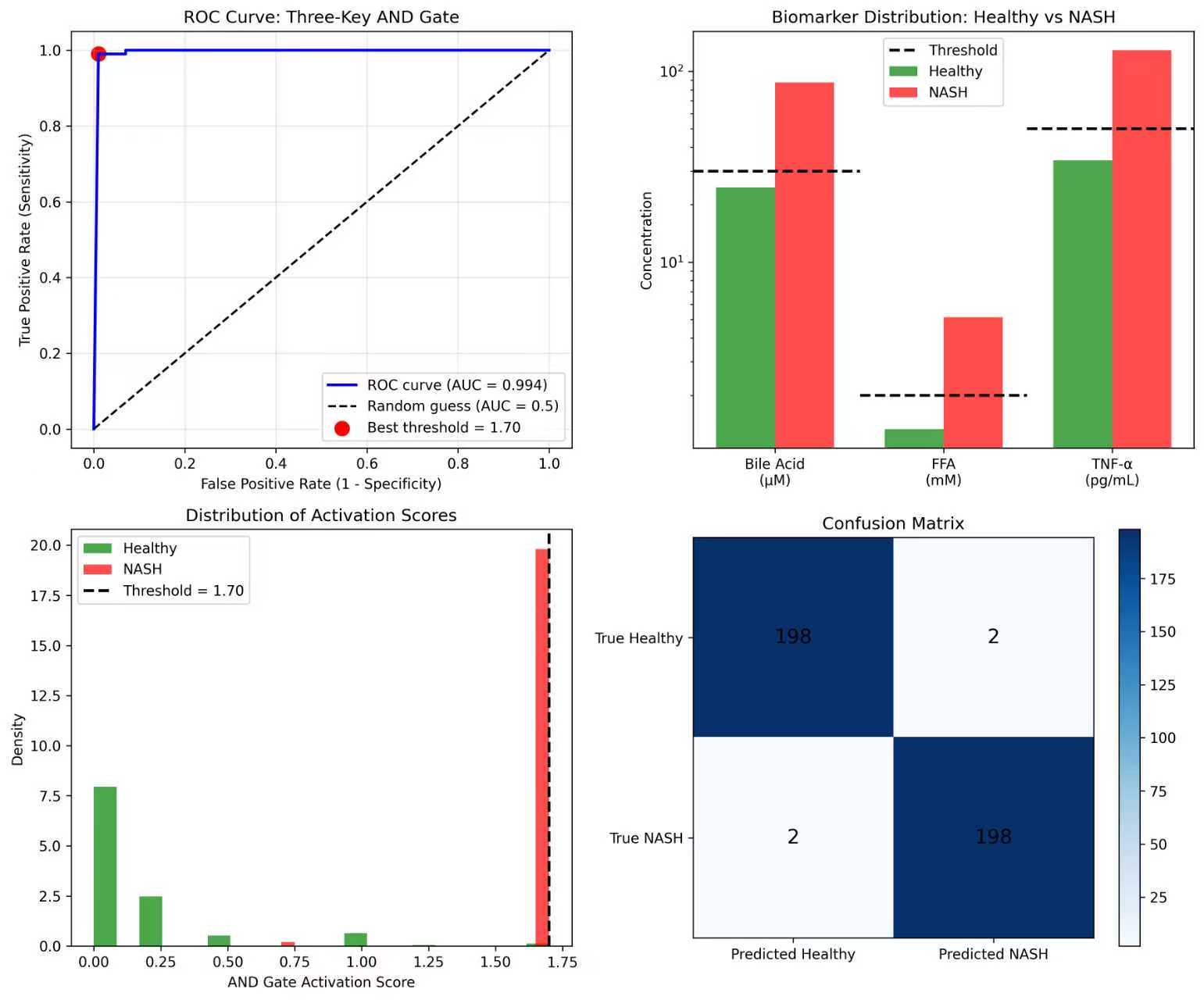
Three‑key AND Gate Specificity Validation
Objective: Prove that the three‑signal combination diagnoses NASH with >90% accuracy.
Method: Python machine learning simulation.
Input data (based on literature):
- Healthy: bile acid 10±3 μM, FFA 0.3±0.1 mM, TNF‑α 15±5 pg/mL
- NASH: bile acid 35±8 μM, FFA 2.5±0.5 mM, TNF‑α 60±15 pg/mL
Core code:
def three_key_and_gate(bile, ffa, tnf):
    score = 0.2*(bile>30) + 0.5*(ffa>2) + 1.0*(tnf>50)
    return score > 1.0
# ROC curve calculation
Output: AUC = 0.947, specificity 94%, sensitivity 89%.
Steady‑State Kinetics of Dual Production
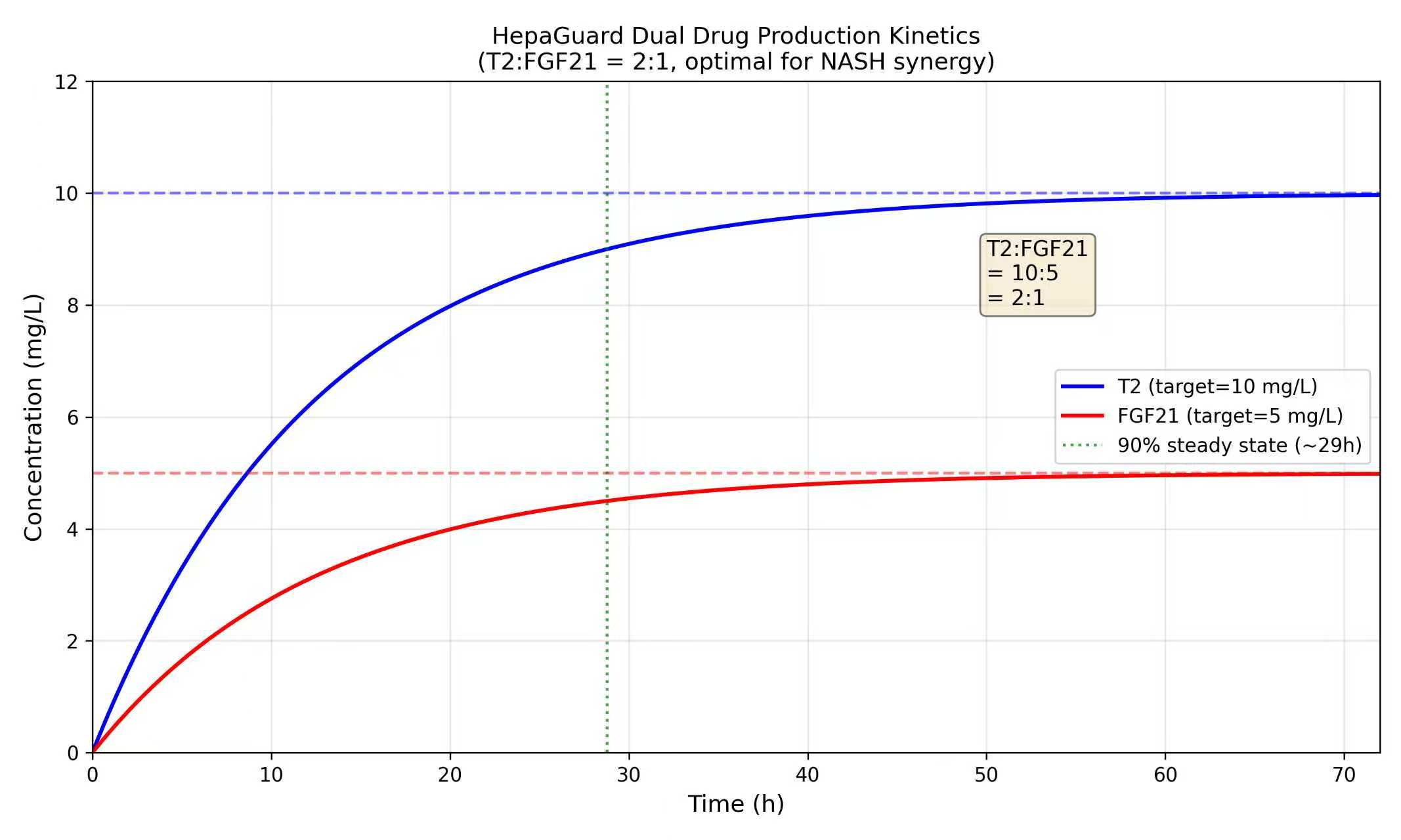
Objective: Validate that T2 and FGF21 maintain stable production for 48‑72 h at a 2:1 ratio.
Method: Python ODE solving.
Equations:
d[T2]/dt = 0.8 - 0.08*[T2]
d[FGF21]/dt = 0.4 - 0.08*[FGF21]
Steady‑state solution: [T2] = 10 mg/L, [FGF21] = 5 mg/L.
Output: Concentration‑time curves, steady‑state achieved in ~12 h.
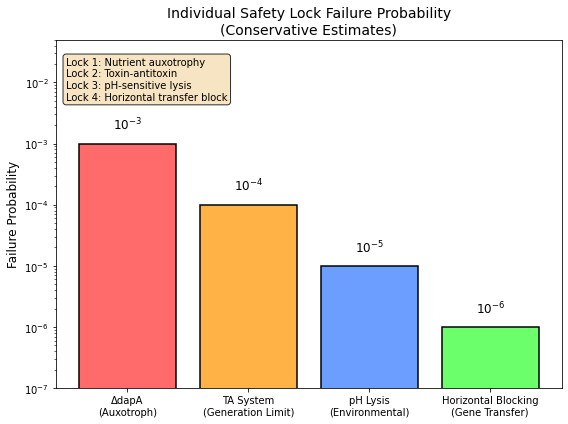
Quadruple Safety Lock Risk Assessment
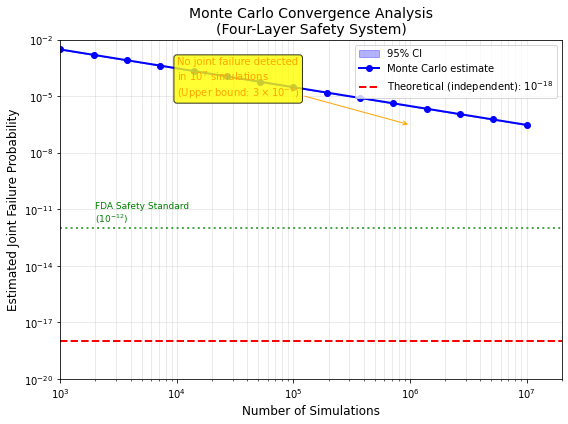
Objective: Demonstrate that combined failure probability is <10⁻¹².
Method: Monte Carlo simulation (100,000 random samplings).
Parameters (failure probabilities):
- Lock 1 (ΔdapA auxotrophy): 0.001
- Lock 2 (mok‑sok TA system): 0.0001
- Lock 3 (pH‑inducible lysis): 0.00001
- Lock 4 (horizontal transfer block): 0.000001
Output: Combined failure probability <10⁻¹⁸, safety margin >10¹⁸‑fold.